Documentation of Russian war crimes. Research reviewed on 11 October 2026.
On the square outside the Mariupol Drama Theatre, one word had been painted so large that it was visible on satellite imagery: ‘ДЕТИ’ — ‘children’. The word appeared in front of and behind the building. Inside, hundreds of civilians were sheltering from the siege of the port city. On 16 March 2022, a massive explosion devastated the theatre.
The attack has become one of the most extensively investigated individual incidents of the siege of Mariupol. Amnesty International, Human Rights Watch and other investigators examined witness testimony, photographs, video footage, satellite imagery and the pattern of destruction. After a months-long investigation, Amnesty concluded that Russian forces most likely struck the theatre with two 500-kilogram bombs dropped from an aircraft and that the attack was a war crime. Human Rights Watch has described the incident as an apparently unlawful Russian attack and said that deliberately targeting a civilian object would constitute a war crime.
A theatre turned into a shelter
By March 2022, Mariupol was largely encircled by Russian and Russia-aligned forces. Electricity, water, communications and heating had failed across large parts of the city. Civilians sought protection in basements and larger public buildings. The Donetsk Academic Regional Drama Theatre in the city centre became an important shelter and a distribution point for humanitarian supplies.
Human Rights Watch spoke with people who had escaped Mariupol even before the strike. One doctor said she had recently seen between 500 and 800 civilians in the theatre. A volunteer distributing food, water and medicine estimated that between 500 and 700 people were there. Later investigations likewise concluded that several hundred people were inside the building on the day of the attack.
Its civilian use was not concealed. People cooked outside, collected water and moved around the site in civilian clothing. Large Cyrillic letters spelling ‘children’ had been painted on the ground in front of and behind the theatre. Satellite images from 14 March clearly show the markings.
16 March 2022
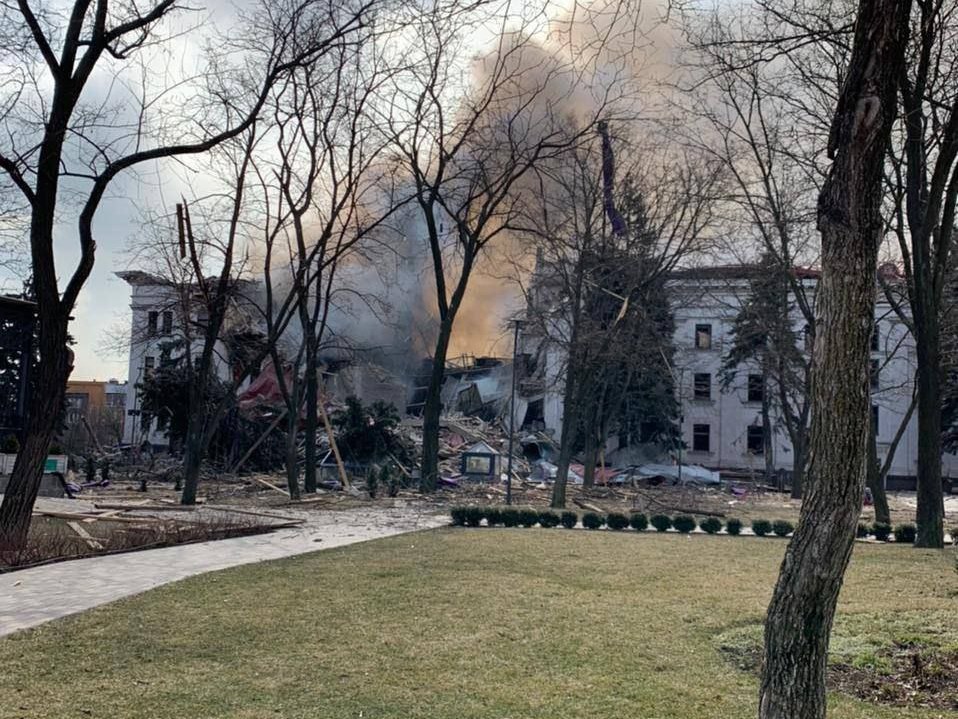
On the morning of 16 March, a powerful explosion struck the central section of the theatre. Images and videos recorded immediately afterwards show extensive destruction and smoke. The central part of the roof and large sections of the internal structure collapsed. Many people were in the basement and other protected areas, which appears to have saved numerous lives.
Amnesty International reconstructed the attack using 53 first-hand accounts, including testimony from 28 people who were inside the theatre or in its immediate vicinity. Investigators also analysed satellite images, radar and flight data, photographs and video. A physicist commissioned by Amnesty modelled the blast. According to the organisation, the damage was most consistent with two aircraft bombs of roughly 500 kilograms each detonating almost simultaneously.
Amnesty explicitly tested alternative explanations, including Russia’s claim that Ukrainian forces had blown up the building themselves. It found no convincing evidence for that account. The combination of the damage pattern, witness testimony and Russian air operations over Mariupol at the time led the organisation to conclude that a Russian air strike was by far the most plausible explanation.
What is known about the death toll — and what is not
Few aspects of the attack remain as uncertain as the number of people killed. The reasons include the chaotic conditions during the siege, the subsequent Russian occupation of the city and the lack of unrestricted access to the site and official records.
Amnesty International was able to verify at least 12 deaths and considered the real toll likely to be significantly higher. Human Rights Watch later documented at least 15 deaths while stressing that the total could not be established. Ukrainian authorities initially reported around 300 deaths. An Associated Press investigation later estimated that as many as 600 people may have been killed. Those higher figures have not been independently verified to the same degree as the documented minimum figures.
KIVOZ therefore does not present any single high estimate as a confirmed death toll. The evidence supports several points: hundreds of civilians were sheltering in the theatre; at least a double-digit number of deaths have been independently documented; and the true number may have been considerably higher. Claims that ‘600 people were killed’ should be identified as an investigative estimate rather than an established final count.
Was there a military target?
The legal assessment depends in part on whether the theatre itself, or a target in its immediate vicinity, was making an effective contribution to military action. Human Rights Watch found no evidence that Ukrainian forces were stationed inside or immediately around the theatre at the time of the attack. Witnesses said Ukrainian soldiers occasionally delivered humanitarian supplies or patrolled nearby. That does not automatically turn a civilian shelter into a military objective.
Amnesty likewise found no evidence among the 28 survivors and other witnesses it interviewed that the theatre was being used as a military base, weapons store or launch point for attacks. It concluded that the most plausible explanation was a deliberate attack on a civilian object.
Why the legal assessment matters
International humanitarian law requires parties to a conflict to distinguish at all times between military objectives and civilians or civilian objects. A theatre is, by default, a civilian object. Where there is doubt about whether a normally civilian building is being used for military purposes, that status cannot simply be assumed away. Direct attacks on civilians and civilian objects are prohibited, as are indiscriminate and disproportionate attacks.
Amnesty International described the strike as a ‘clear war crime’. Human Rights Watch has characterised it as an apparently unlawful Russian attack and has said that, if deliberate targeting of a civilian object is established, it would amount to a war crime. Senior OSCE officials also condemned the bombing shortly after it occurred, noting that the building was visibly sheltering civilians.
Those legal assessments are significant, but they are not the same as a criminal conviction of a specific individual. Individual criminal responsibility requires investigators and courts to determine who ordered, planned and carried out the strike, what information they possessed and how the chain of command operated. Establishing that an attack violated international humanitarian law is not automatically equivalent to a final judgment against a named perpetrator.
Russia’s account
Russia denied responsibility and claimed that Ukraine’s Azov Regiment had blown up the theatre. Independent investigations have found no convincing evidence supporting that version. Amnesty examined possible alternative causes of the explosion and concluded that a Russian air strike was overwhelmingly the most plausible explanation. Later work by Human Rights Watch, SITU Research and Truth Hounds likewise did not substantiate the Russian claim.
The Russian account nevertheless belongs in a serious documentation of the case because investigations into alleged war crimes must test competing hypotheses. It is not rejected merely because it originated with Russia; it is rejected because the available physical and digital evidence, witness statements and independent analyses point elsewhere.
Mariupol as a wider pattern of destruction
The theatre strike was not an isolated event. Human Rights Watch documented extensive damage to residential buildings and civilian infrastructure across Mariupol. In one area it examined, 93 percent of high-rise apartment buildings were damaged; 97 percent of educational facilities and all of the city’s hospitals showed damage. Large parts of the population had been cut off from water and electricity from early March.
Those figures do not prove that every individual instance of destruction was a war crime. Fighting in densely built-up areas can produce enormous civilian damage even when attacks are directed at military objectives. They do, however, explain the setting in which the theatre became a shelter: civilians had fewer and fewer places where they could hope to be safe.
Evidence under occupation
After Russian forces took control of Mariupol, Russian occupation authorities controlled access to the site. That has made independent forensic examination more difficult. The theatre was later reconstructed under occupation, prompting criticism from human-rights organisations and Ukrainian authorities that potential physical evidence could be lost. At the same time, a substantial digital record had already been preserved, including satellite imagery, video, photographs and witness testimony.
That documentation could be important in future criminal proceedings. Modern war-crimes investigations no longer depend solely on immediate access to a crime scene. Geolocated footage, satellite data, communications records and open-source material can help reconstruct events, provided they are preserved to forensic standards and assessed alongside witness evidence.
What can be stated with confidence
Four elements are particularly well supported by independent investigations. On 16 March 2022, the theatre was a clearly identifiable civilian shelter; several hundred civilians were inside; a major attack destroyed much of the building; and the strongest body of evidence points to a Russian air strike using large aircraft bombs. There is no credible evidence of military use that would explain an attack of the kind documented.
The exact death toll and the individual criminal responsibility of particular commanders or aircrew remain uncertain. That uncertainty does not erase the well-documented core facts. It is instead a reason to describe numbers and legal conclusions precisely.
The Mariupol Drama Theatre has therefore come to represent more than the destruction of a single building. It demonstrates that markings such as ‘children’ provide protection only when belligerents comply with the rules of war. It also demonstrates why independent documentation matters: not to produce the largest possible number, but to turn the chaos of war into a record that can be tested against evidence.
Quellen
- Amnesty International – Deadly Mariupol theatre strike ‘a clear war crime’
- Amnesty International – ‘Children’: The attack on the Donetsk Regional Academic Drama Theatre
- Human Rights Watch – Mariupol Theater Hit by Russian Attack Sheltered Hundreds
- Human Rights Watch – Beneath the Rubble: Documenting Devastation and Loss in Mariupol
- OSCE – Chairman-in-Office and Secretary General condemn bombing of Mariupol
- Human Rights Watch – A City Devastated: damage assessment of Mariupol
Redaktioneller Hinweis: Research and links reviewed on 11 October 2026. The death toll remains uncertain; independently documented minimum figures and higher estimates are clearly distinguished. No final individual criminal conviction is asserted.