
Documentation of Russian war crimes — research and update status: 12 October 2026.
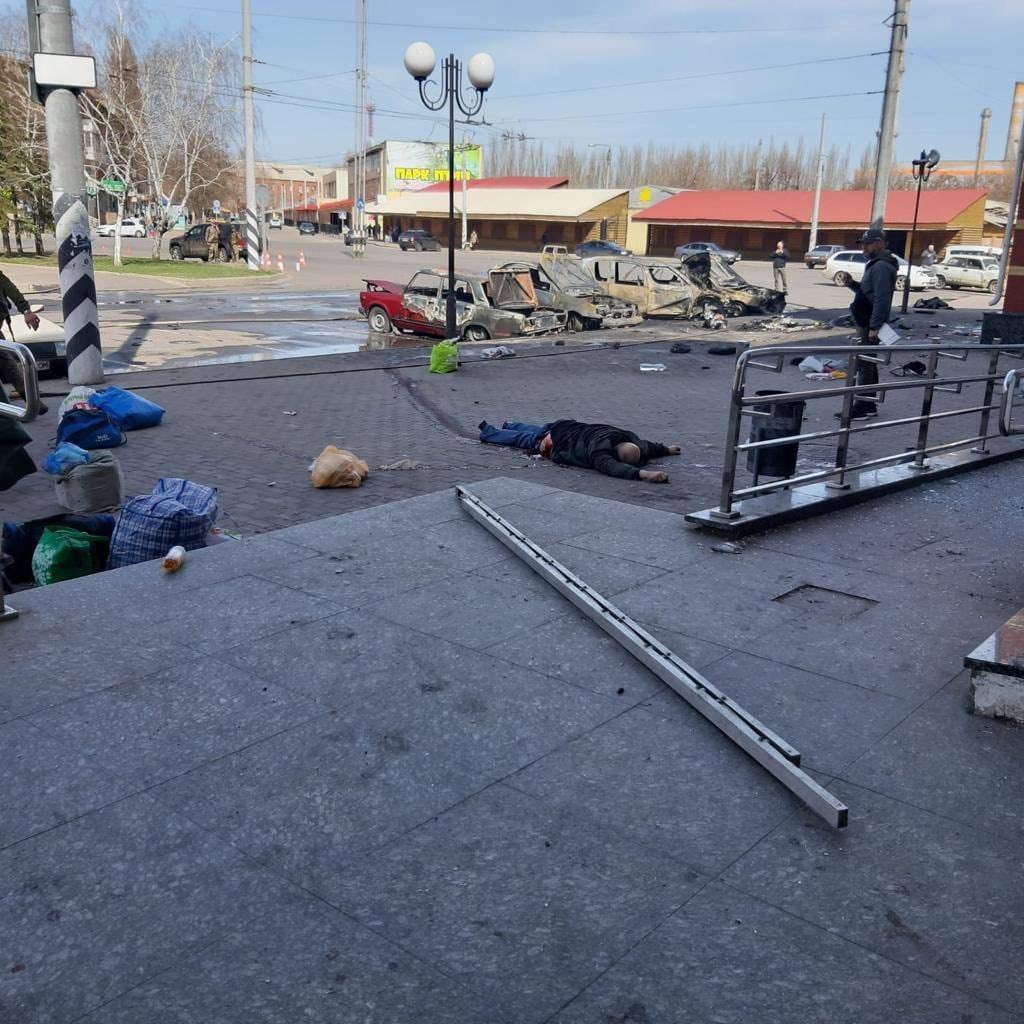
On the morning of 8 April 2022, Kramatorsk railway station was not an ordinary transport hub. It was a place of escape. In the days before the attack, Ukrainian authorities had urged residents of the Donetsk region to evacuate ahead of an expected Russian offensive. Tens of thousands of people were using the railway to leave eastern Ukraine. According to the later reconstruction by Human Rights Watch and SITU Research, more than 500 civilians were at the station when a ballistic missile exploded above the site at 10:28 a.m.
The missile carried a cluster-munition warhead. Dozens of submunitions spread across the platforms, tracks and surrounding area. Human Rights Watch’s conservative count documented at least 58 civilians killed and more than 100 injured. Later Ukrainian figures reported 63 dead and more than 150 injured. The difference is not a contradiction that journalism can resolve by choosing a supposedly exact number: investigations were conducted at different times and used different verification standards. What is firmly established is that dozens of people were killed, including children.
A railway station used for evacuation
The civilian function of the site is central to the legal assessment. Kramatorsk was close to active fighting in 2022, and railway infrastructure can in principle also serve military purposes. A railway station is therefore not automatically a protected civilian object under every possible circumstance. The relevant questions are its concrete use, the anticipated military advantage and the obligation to avoid or minimise harm to civilians.
Human Rights Watch investigated the attack over several months. Its staff were in Kramatorsk from 14 to 24 May 2022, interviewed 69 people — including survivors, relatives, first responders, medical staff, officials and investigators — and analysed more than 200 photographs and videos. The investigation also examined satellite imagery and a former Russian military position near Kunie in the Kharkiv region.
The organisation found evidence that the wider rail network had some limited military use, but no evidence that Ukrainian troops or military equipment were present on the station platforms at the time of the attack. At the same time, the station’s role as an evacuation hub was publicly known. Train schedules and evacuation notices had been widely circulated.
What the reconstruction found about the weapon
The investigation concluded that a Tochka-U missile was used. Its cluster-munition warhead opened in the air and dispersed numerous smaller explosive submunitions across a wide area. That is precisely what makes such weapons particularly dangerous: instead of concentrating explosive force in a tightly defined point, they distribute it over a large footprint.
Human Rights Watch and SITU Research concluded that the missile was probably launched from territory near Kunie that was then controlled by Russian forces. After the area was retaken, investigators examined former Russian positions and found material associated with Tochka-U systems. Satellite imagery and other visual evidence supported the reconstruction.
Russia denied responsibility and claimed, among other things, that its armed forces no longer used the Tochka-U. Human Rights Watch, however, documented evidence that Russian forces had access to such systems in Ukraine during the relevant period. The organisation therefore considers Russian responsibility convincingly established.
Why cluster munitions are so dangerous
Cluster munitions disperse many individual explosive devices over a larger area. Some may fail to detonate and remain as unexploded ordnance, continuing to endanger people long after an attack. More than one hundred states have joined the Convention on Cluster Munitions, which prohibits their use, production and transfer. Russia and Ukraine are not parties to that treaty.
That does not mean every use outside the convention is legally unrestricted. The fundamental rules of international humanitarian law apply regardless of treaty membership: parties to a conflict must distinguish between military objectives and civilians; indiscriminate attacks are prohibited; and expected civilian harm must not be excessive in relation to the concrete and direct military advantage anticipated.
The use of an area-effect weapon at a location where hundreds of civilians were crowded together while waiting for evacuation trains is therefore central to the legal assessment.
The legal assessment
Human Rights Watch describes the attack as unlawful and as an apparent war crime. That wording matters. It means the organisation believes its investigation points to a serious violation of the laws of war that could give rise to criminal responsibility. It is not the same as a final criminal judgment by a competent court against specific individuals.
Individual criminal responsibility would require investigators to establish who planned, ordered and carried out the attack, what information about the station was available to them and with what knowledge or intent they acted. Those are questions for criminal investigations and courts.
Even at the objective level, however, the case is grave. Even if one assumes for the sake of argument that parts of the railway infrastructure had a military function, the choice of a cluster-munition weapon at a time when the station was packed with civilians remains highly problematic under international humanitarian law. Human Rights Watch concluded that the attack was indiscriminate and, in any event, disproportionate.
Russia’s counterclaims
After the attack, Russian authorities circulated several explanations denying Russian responsibility. One central claim was that Russia did not use the missile type involved. Such statements were one reason later investigators carried out a detailed technical reconstruction.
Serious documentation has to report counterclaims without automatically giving them the same evidentiary weight as verified findings. The Human Rights Watch investigation draws on witness testimony, geolocation, satellite imagery, weapons analysis and examination of former Russian positions. No alternative reconstruction is known that convincingly accounts for this body of evidence and establishes Ukrainian responsibility.
An attack on people trying to escape
Kramatorsk station became emblematic of a form of warfare in which civilian movement itself becomes dangerous. The people there were not simply gathered by chance near a contested location. Many were following official advice to leave an area expected to become a major battlefield. Evacuation is meant to reduce civilian casualties. An attack on a known evacuation hub reverses that logic of protection.
The long-term significance of the case therefore lies in more than the casualty count. The painstaking reconstruction illustrates how modern war-crimes documentation works: witness accounts are checked against photographs, video, satellite data, weapons remnants and geographic information. Where evidence is insufficient, uncertainty has to be stated. Where several independent chains of evidence converge, responsibility can be described more clearly.
What is established — and what is not
It is well documented that on 8 April 2022 a Tochka-U missile carrying a cluster-munition warhead exploded over Kramatorsk railway station, that hundreds of civilians were waiting there for evacuation and that dozens were killed and more than one hundred injured. The extensive investigation by Human Rights Watch and SITU Research attributes the attack to Russian forces and assesses it as an unlawful, apparent war crime.
What has not been finally established in a criminal judgment is the individual guilt of specific Russian commanders or missile crews. That distinction does not weaken the documented facts. It is essential to precise war-crimes reporting, which should not replace legal proof with political certainty.
Kramatorsk shows why that precision matters. In an attack this serious, the strongest case does not need exaggeration. It emerges from a careful reconstruction of what the evidence can demonstrate.
Quellen
- Human Rights Watch – Ukraine: New Findings on Russia's Kramatorsk Train Station Attack, 21.02.2023
- Wikimedia Commons – Kramatorsk railway bombing 2022 April 8 (2), image and licence information

Redaktioneller Hinweis: Research and update status: 12 October 2026. Casualty figures are separated by source; the term 'apparent war crime' follows Human Rights Watch's legal assessment and is not an individual criminal judgment.