Updated: 14 October 2026, 09:15 CEST.
When Ukrainian forces retook Izium in September 2022, the city became more than a symbol of Russia’s military retreat. Evidence emerged of an occupation in which civilians had been arbitrarily detained, abused and tortured. Human Rights Watch interviewed more than 100 people who had remained in the city during roughly six months of Russian control.
Fifteen interviewees — fourteen men and one woman — described being tortured themselves. Only one had ties to Ukraine’s armed forces; the others were civilians. Accounts showed striking similarities across different detention sites.
At least seven detention sites
Survivors identified at least seven facilities allegedly used by Russian or Russian-affiliated forces as bases and detention centres, including two schools, a police station, a former hospital compound, a water facility, a private house and a factory. HRW entered four and verified their use for detention.
Documented abuse included severe beatings, electric shocks, waterboarding, threats with firearms and forced stress positions. Detainees said interrogators demanded information about Ukrainian police, territorial defence members and veterans, or asked about their attitude towards Russia.
The repetition matters legally. HRW concluded the violence did not resemble isolated excesses. Similar methods across multiple facilities indicated a pattern. Torture is absolutely prohibited under international humanitarian law and, when committed against protected persons in occupied territory, can constitute a war crime.
The forest outside Izium
Ukrainian authorities also discovered an improvised burial site containing more than 440 graves. Amnesty International cautioned that the discovery required investigation rather than assuming one cause of death for everyone buried there. Civilians and soldiers were among the dead; people may have died from shelling, combat, lack of medical care or unlawful killing.
That distinction is essential. A mass burial site does not by itself prove a massacre. At the same time, investigators reported signs of torture on some bodies, and HRW says at least three detained men were killed by Russian forces and later found in the forest.
What the evidence establishes
The strongest evidence concerns systematic torture and abuse in detention. HRW based its findings on direct interviews, site visits and mutually reinforcing testimony. UN human-rights monitors have documented a broader pattern of arbitrary detention, enforced disappearance and torture in Russian-occupied areas.
This does not assign every unexplained death in Izium to a particular perpetrator. Individual criminal responsibility requires evidence about actors, orders and specific conduct. Pattern evidence cannot replace that proof, but it can be crucial to later investigations.
Why Izium matters beyond one city
Rights organisations found similar structures after Russian withdrawals from Bucha, parts of Kherson region and other occupied areas: improvised detention facilities, electric shocks, beatings, threats and disappearances. In 2026 HRW summarised continuing evidence of summary executions, torture, sexual violence and enforced disappearances by Russian forces in occupied territories.
Izium therefore helps explain why war-crimes investigations must look beyond individual notorious sites. The key question is whether recurring methods, personnel and command structures can be connected.
Documentation without shock imagery
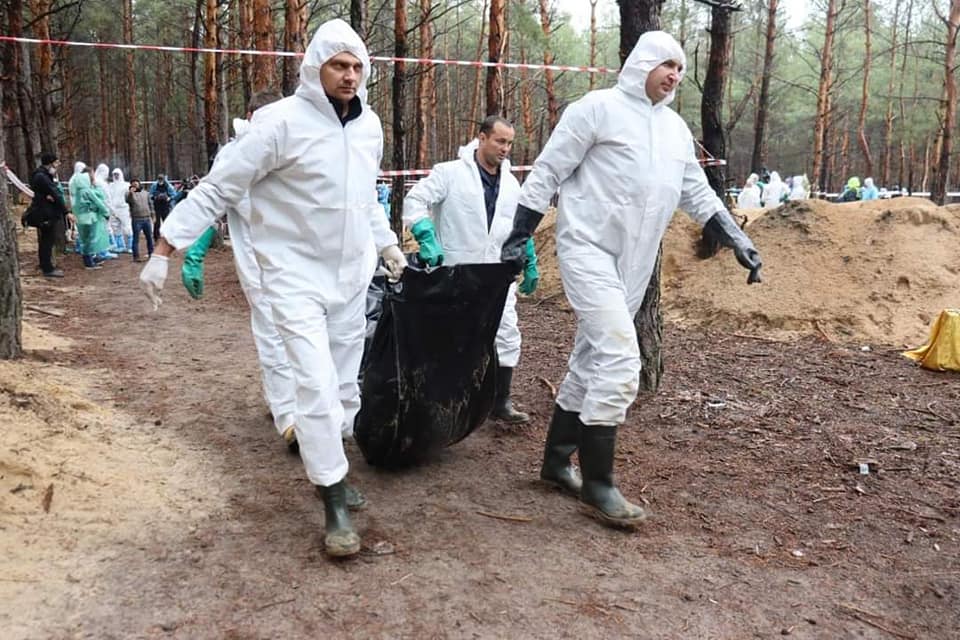
The accompanying image shows the burial ground near Izium after exhumations began. No victims are visible. The photograph is credited to the National Police of Ukraine and is available through Wikimedia Commons under CC BY 4.0. It documents the investigative site, not the cause of death of every person buried there.
Four years after liberation, legal accountability remains incomplete. But the evidence for torture during Russian occupation supports a clear conclusion: the documented acts violate the absolute prohibition on torture and may be prosecuted as war crimes. In many individual cases, identifying criminally responsible persons remains unfinished. Keeping documented acts separate from individual guilt is essential to serious war-crimes reporting.
Quellen
- Human Rights Watch – Ukraine: Russian Forces Tortured Izium Detainees
- Amnesty International – Mass graves in Izium
- OHCHR – UN reports on arbitrary detention and torture
- Human Rights Watch – Russia's War on Ukraine Four Years On
Redaktioneller Hinweis: Research and link check: 14 October 2026, 09:15 CEST. Burial and casualty figures are attributed to their respective sources.