
Updated: 13 October 2026, 09:10 CEST.
The basement of Yahidne’s school is now a place of remembrance. Names and dates remain on its walls. They were written in March 2022, when Russian forces forced hundreds of residents of the village south of Chernihiv into rooms without enough space, ventilation, water or sanitation for so many people.
Yahidne is one of the best-documented cases of Russian abuse of civilians during the invasion. Human Rights Watch, the UN Commission of Inquiry, UN human-rights monitors and the OSCE have investigated the site and witness accounts. Their totals vary slightly, from roughly 350 to 367 detainees, reflecting different counting methods rather than disagreement over the core events.
Occupation in early March
Russian troops seized Yahidne during the failed advance toward Chernihiv and Kyiv. Human Rights Watch reconstructs that Russian forces regained control on 4 March and ordered residents to gather at the school. Many were then confined in its basement.
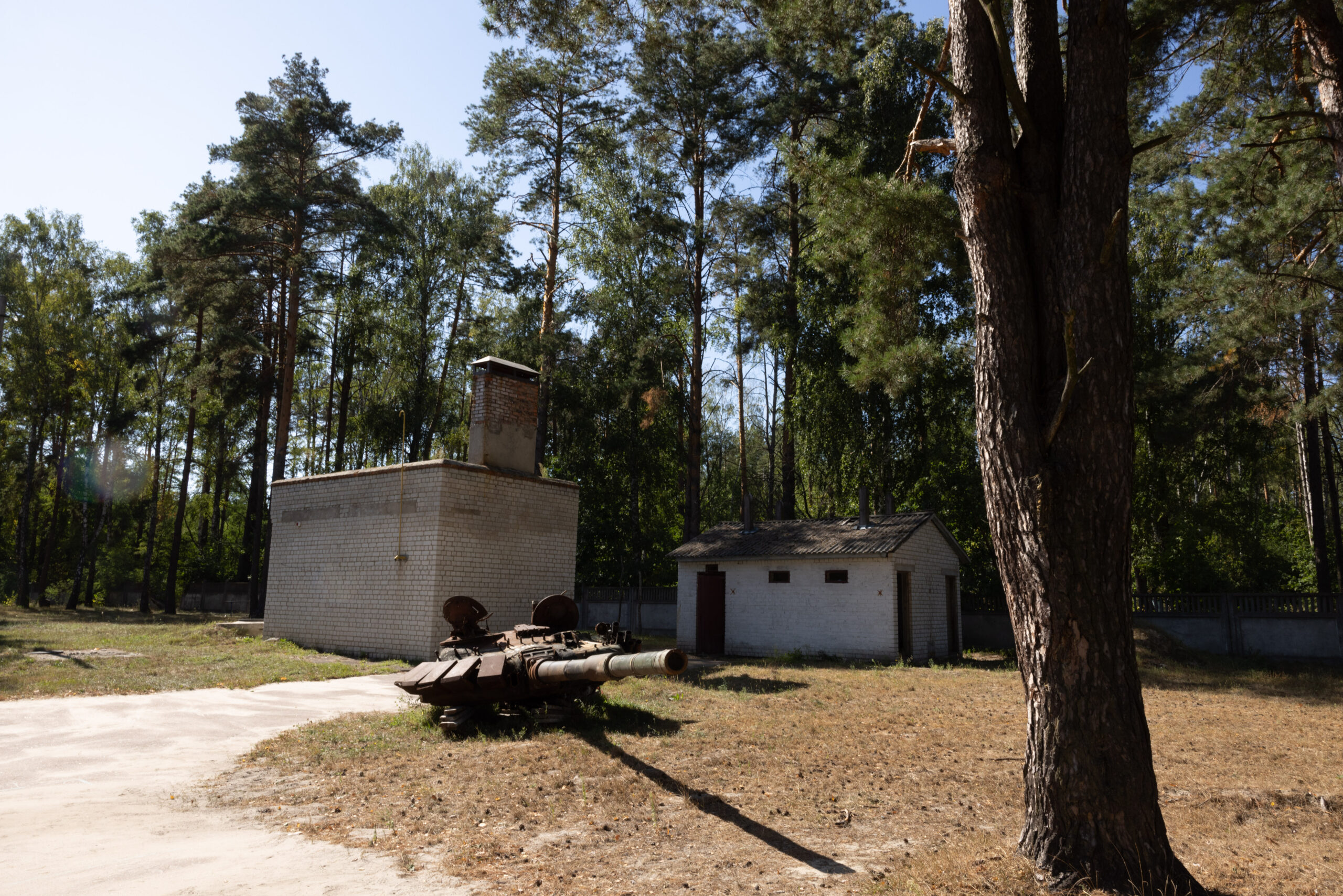
At the same time, Russian soldiers used the school as a military base. Satellite imagery and site inspections showed military vehicles at the building and in dug-in positions. The UN Commission of Inquiry documented Russian forces attacking Ukrainian positions from the school grounds.
This created a double danger. Civilians were deprived of liberty while being held inside an object used for military purposes. International humanitarian law requires parties to take feasible precautions to protect civilians from the effects of attacks. Using civilians deliberately to shield military objectives is prohibited.
Crowding, darkness and little air
Conditions were catastrophic according to converging accounts. People had to sit or stand tightly packed together. Sanitation was grossly inadequate, clean water scarce and ventilation poor. Children, babies, older people and people with disabilities were among those confined.
The UN Human Rights Monitoring Mission describes around 360 civilians held for nearly a month without proper toilets, clean water or ventilation, with ten older people dying as a result of the conditions. Other sources give eleven deaths in the basement. Villagers were also killed outside. These figures should not be merged into a false precision.
Residents wrote names and dates of death on walls and doors. Those markings later became some of the most visible evidence of the occupation. Survivors left the basement at the end of March as Russian forces withdrew from the region.
What independent investigations found
Human Rights Watch concluded after interviews and a site visit that Russian forces unlawfully held nearly 350 civilians for a month and endangered them further by using the school as a military base.
The independent UN Commission of Inquiry documented 365 confined civilians and Russian military use of the same building. The OSCE has cited Yahidne as a prominent example of collective arbitrary deprivation of liberty, while an OSCE expert mission found evidence relevant to the prohibition on using civilians as human shields.
In 2024 the UN Human Rights Office reported Ukrainian court verdicts against 15 Russian servicemen for detaining civilians in inhumane conditions in the Yahidne school basement. The defendants were tried in absentia. OHCHR explicitly noted due-process concerns surrounding notification and waiver of the right to be present. Those verdicts are therefore part of the legal record, not a substitute for international investigation.
The legal framework
Arbitrary confinement of civilians in an international armed conflict can constitute a grave violation of international humanitarian law. Inhuman treatment is prohibited, as is using civilians to render military operations or objectives immune from attack.
Individual criminal responsibility still requires evidence showing which soldier or commander committed, ordered, assisted or knowingly failed to prevent particular acts. The extensive documentation of Yahidne does not replace that individual proof, but it provides an unusually dense factual record.
That is why Yahidne matters journalistically. The case does not rest on a single witness or solely on Ukrainian government statements. Multiple independent international institutions investigated the site and confirmed central elements.
A crime without a spectacular weapon
Many images of Russia’s invasion show missile craters and destroyed apartment blocks. Yahidne is a reminder that grave wartime abuses can occur without a single spectacular strike. Here, violence took the form of control: civilians were confined, deprived of basic needs and held beside military forces.
The school is being preserved as a memorial. The rooms, wall inscriptions, photographs, satellite imagery and witness accounts form a record against forgetting. They also show why precise language matters: not every civilian tragedy in war is automatically a war crime. In Yahidne, however, the collective arbitrary detention and documented inhuman conditions are so extensively established by the UN, OSCE and human-rights investigators that the case stands among the clearest documented grave abuses of Russia’s occupation.
Quellen
- Human Rights Watch – Russian, Ukrainian Bases Endangering Civilians
- Human Rights Watch – Executions, Torture During Russian Occupation
- UN Human Rights – devastating impact on older people
- OSCE/ODIHR – report on collective detention
Redaktioneller Hinweis: Research and link check: 13 October 2026, 09:10 CEST. Detainee and death totals are kept source-specific where accounts differ.