
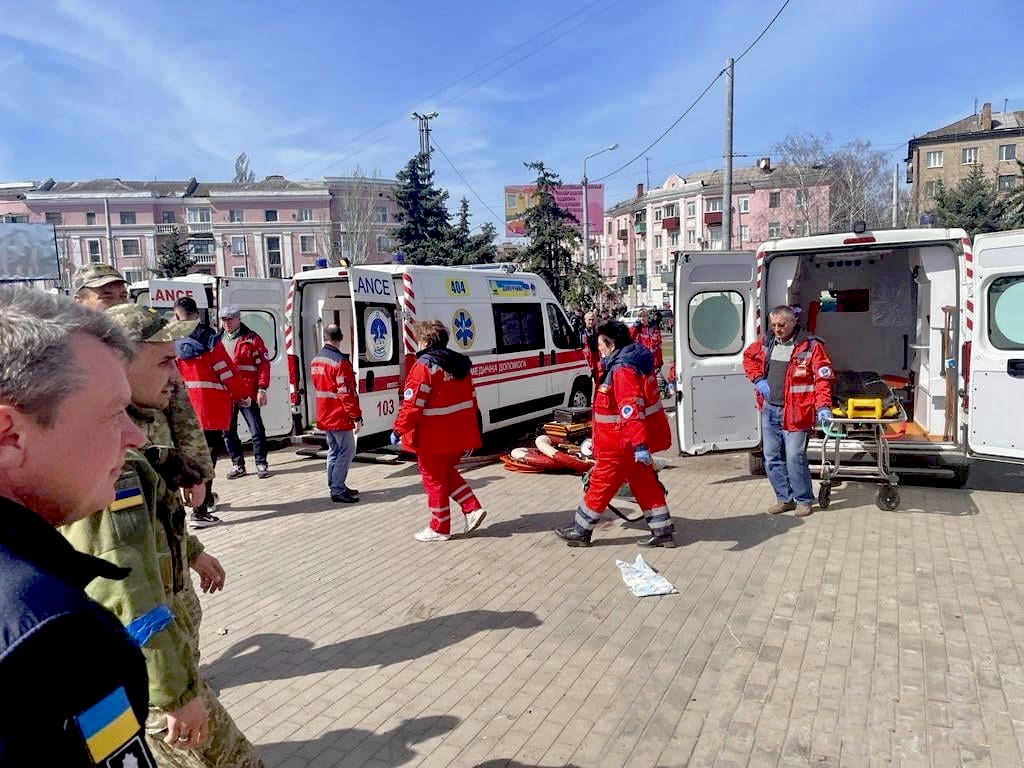
A station that offered a way out
On the morning of 8 April 2022, hundreds of people gathered at Kramatorsk railway station in eastern Ukraine, hoping to leave an area threatened by advancing fighting. Some carried luggage; others were travelling with children or elderly relatives. The Russian full-scale invasion had transformed an ordinary transport hub into an evacuation point. A ballistic missile carrying a cluster munition warhead struck the station area and released numerous smaller explosive devices. People waiting for trains were killed and injured. The attack became one of the most thoroughly investigated incidents involving civilian casualties in the early months of the invasion. Reconstructing it requires more than repeating an emotional headline. Casualty totals, weapon identification, the attribution of responsibility and the requirements of international humanitarian law must be examined separately. Each is supported by different kinds of evidence, and each has limits that responsible reporting should make visible.
The morning of the strike
Human Rights Watch and SITU Research reconstructed the attack using witness testimony, images, video, spatial analysis and technical evidence. Their account describes a busy evacuation station struck by a missile that dispersed submunitions over a wide area. The station was widely known as a place where civilians sought transport away from the fighting. The immediate human consequences were devastating, with numerous deaths and serious injuries among people trying to escape. The fact of the strike and the civilian casualties is well documented. Other questions require greater care. The identity of each person in the chain of command, the exact orders issued and the knowledge held by particular officers cannot simply be inferred from photographs of the aftermath. An independent investigation can establish a powerful evidentiary account without becoming a criminal trial. This distinction matters when discussing accountability.
Why different death tolls appear
Human Rights Watch and SITU Research reported at least 58 civilians killed and more than 100 injured in their February 2023 investigation. Other reporting cited local authorities who later gave a death toll of 61 and more than 160 injured. These figures should not be silently combined or presented as if they were identical counts. Early casualty reporting is provisional: injured people may subsequently die, victims may take time to identify and different investigators may apply different verification standards. A cautious retrospective article therefore identifies the source and date of each figure. KIVOZ uses the independently documented minimum of at least 58 civilian deaths and over 100 injuries as its principal figure, while noting the higher local-authority totals. Differences in reporting are not evidence that the attack was fabricated. They are a reminder that verification is a process, especially after a mass-casualty incident.
The missile and the cluster warhead
The joint investigation identified a Tochka-U ballistic missile equipped with a cluster munition warhead. Cluster munitions release multiple smaller explosive submunitions, potentially scattering their effects across a large area rather than confining them to a single point. This makes their use especially dangerous where civilians are concentrated. Some submunitions may also fail to explode immediately, leaving hazards for people returning to the site. Weapon identification involves examining fragments, damage patterns, photographs and the geographical distribution of impacts. Naming the weapon is only the beginning of a legal analysis. Investigators must also consider where it was used, what military objective was allegedly being targeted, what effects could reasonably have been anticipated and whether feasible precautions were taken. The presence of a weapon with wide-area effects at a crowded evacuation site is central to the findings about unlawfulness.
Examining the competing claims of responsibility
Russian authorities denied responsibility and accused Ukraine of launching the missile. Those assertions deserve to be reported as claims, but they do not carry the same evidentiary weight as a detailed independent investigation simply because both sides have spoken. Human Rights Watch and SITU Research examined imagery, possible launch directions, weapon availability and other geographical evidence. They concluded that the evidence pointed to Russian forces launching the missile. Their analysis identified a possible launch area near Kunie in Kharkiv region, which was then under Russian control. A possible launch area is not equivalent to the legally proven identity of a particular launcher crew or commander. Nor should a journalist imply that every technical uncertainty has disappeared. The available investigation supports a strong attribution at the level of forces, while questions of individual criminal responsibility require further evidence and legal process.
The rules protecting civilians
International humanitarian law requires parties to distinguish civilians from combatants and civilian objects from military objectives. Deliberate attacks on civilians are prohibited. Indiscriminate attacks are also prohibited, as are attacks expected to cause excessive incidental civilian harm in relation to the concrete and direct military advantage anticipated. Parties must take feasible precautions to minimise harm to civilians. A railway station could, in some circumstances, have a military function, but the mere possibility of military transport does not turn civilians waiting for evacuation trains into lawful targets. The circumstances in Kramatorsk were particularly grave because the station was known as an evacuation hub and the munition dispersed explosive effects across an area occupied by civilians. Human Rights Watch concluded that the strike violated the laws of war and amounted to an apparent war crime. That is an expert assessment, not a final criminal conviction of a named individual.
Cluster munitions and the treaty question
The Convention on Cluster Munitions prohibits its states parties from using, producing and transferring weapons covered by the treaty. Neither Russia nor Ukraine is a party to that convention. This does not mean that every use of cluster munitions by a non-party is lawful. The general rules of international humanitarian law, including distinction, proportionality and precautions, apply regardless of membership in that specific treaty. It is therefore essential to distinguish a treaty-based prohibition on a weapon category from the legality of a particular attack under general humanitarian law. In Kramatorsk, the effects of dispersing numerous submunitions across a crowded evacuation location are highly relevant. A careful legal assessment examines the foreseeable civilian impact and the claimed military advantage, not merely the label attached to the weapon. Confusing these legal questions can weaken an otherwise well-supported account of the attack.
What independent evidence can establish
The investigation’s strength lies in the combination of several evidence streams. Satellite imagery can help establish locations and conditions; photographs and videos can document damage and sequences of events; witnesses can describe what happened to people at the station; and weapon fragments can support technical identification. None of these sources is perfect in isolation. A photograph does not automatically prove a launch location. A witness may be mistaken about a projectile’s direction. Public footage may omit crucial minutes or viewpoints. Researchers therefore cross-check independent sources and explain the inferences connecting them. The result can be compelling without answering every conceivable question. A criminal prosecution would still need evidence linking specific individuals to acts and decisions, together with the legal elements required for the charges. Public documentation and criminal adjudication serve related but distinct purposes.
Remembering people rather than only numbers
A mass-casualty report risks reducing human beings to statistics. At Kramatorsk, the victims were people trying to leave a dangerous area. Their presence near a front line did not strip them of civilian protection. Nor would the existence of a military objective somewhere nearby eliminate the attacker’s duty to distinguish and take precautions. Families lost relatives while seeking what they hoped would be a safer place. The long-term effects extend beyond the immediate casualty totals to trauma, displacement and the loss of trust in routes intended for evacuation. Photographs from the scene can be important evidence, but they should be used with restraint and clear attribution. The purpose of documenting the strike is not to turn suffering into spectacle. It is to preserve a reliable record, support potential accountability and recognise the people whose lives were changed or ended.
Accountability is a legal process
Human rights organisations can document incidents and publish findings, but they cannot themselves issue binding criminal judgments. The International Criminal Court and national authorities have different potential roles in investigating crimes committed during the war, subject to their jurisdiction and the evidence available in particular cases. The HRW and SITU investigation calls for those responsible for the Kramatorsk attack to be investigated and held accountable. Its conclusion about Russian forces and an apparent war crime is substantial, but it should not be misrepresented as a conviction of a specific commander. Individual liability requires proof of conduct, responsibility and any relevant mental elements. Careful language is not an attempt to minimise the attack. It protects the credibility of the evidence by separating what investigators have established from what a court would still have to determine.
Why the case still matters
The Kramatorsk railway station attack remains a powerful example of the dangers facing civilians even when they are attempting to escape fighting. It also illustrates why claims about wartime responsibility should be tested against technical, geographical and testimonial evidence rather than accepted or rejected on political allegiance alone. The different casualty totals become understandable when their sources and verification stages are disclosed. The legal protections for civilians remain in force near active combat zones. And an investigation can support a strong conclusion about the forces responsible while leaving individual criminal accountability to further proceedings. The central documented facts are stark: a known evacuation station was hit by a missile carrying wide-area explosive submunitions, many civilians were killed, and a detailed independent investigation attributed the attack to Russian forces. Preserving that record is a necessary part of pursuing truth and justice.
Quellen
- https://www.hrw.org/de/news/2023/02/21/ukraine-neue-erkenntnisse-zu-russlands-angriff-auf-bahnhof
- https://www.hrw.org/news/2023/02/21/ukraine-new-light-russias-rail-station-attack
- https://www.icrc.org/en/war-and-law
- https://www.clusterconvention.org/
- https://commons.wikimedia.org/wiki/File:Kramatorsk_after_attack_on_8_April_2022_(02).jpg

Redaktioneller Hinweis: KIVOZ Tagesredaktion 22.11.2026. Quellen, Textumfang und Sprachzuordnung redaktionell geprüft. WordPress nicht synchronisiert.