
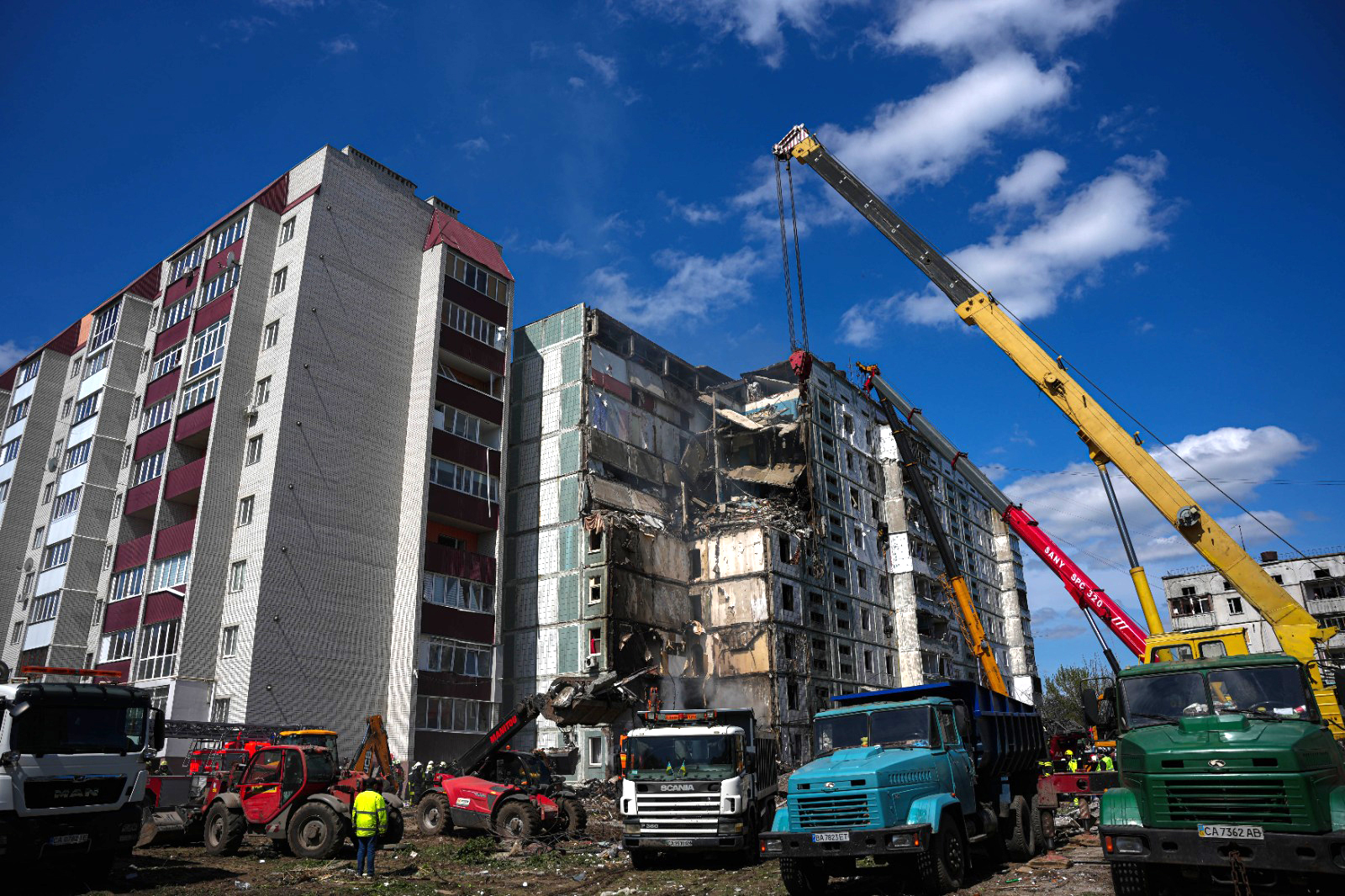
A residential building struck before dawn
In the early hours of 28 April 2023, missiles struck the Ukrainian city of Uman in Cherkasy region. A multi-storey apartment building at 25 Zakhysnykiv Ukrainy Street suffered catastrophic damage. Parts of the structure collapsed, apartments were destroyed and residents were trapped under the debris. The attack became one of the most widely reported strikes on civilian housing away from the immediate front line. It was subsequently investigated by the Independent International Commission of Inquiry on Ukraine, established by the United Nations Human Rights Council. The commission’s report to the UN General Assembly provides a detailed basis for assessing the timeline, casualties, probable weapon and the legal significance of the target. It is a more reliable starting point than the rapidly changing casualty figures reported during the first hours of the rescue operation.
The commission’s reconstruction
According to the commission’s report A/78/540, two missiles struck Uman between approximately 4:20 and 4:30 a.m. One hit the residential building and another struck a warehouse. The commission placed the event within a larger wave of long-range strikes carried out by Russian armed forces. Russian authorities acknowledged a major strike operation that night, although that acknowledgment must not be confused with an admission that the apartment building itself was deliberately targeted. The commission assessed that the weapon used appeared to be a Kh-101 cruise missile. This is a reasoned technical assessment based on the evidence available to investigators, not a publicly released complete operational record. The distinction matters when assessing what is established and what remains to be investigated.
Why the death toll appears as 23 or 24
Early reports from a disaster scene often change as rescuers recover bodies and investigators establish identities. On 29 April 2023, Ukraine’s interior minister reported that 23 people had died, including six children, following the completion of the search operation. The New Voice of Ukraine recorded that statement and the authorities’ efforts to identify victims. The later UN commission report, however, recorded 24 civilians killed: 14 women, four men, three boys and three girls. These are not figures that should be blended or presented as interchangeable. They come from different reporting stages and methods. For a retrospective account, the commission’s figure of 24 provides a documented reference point, while the earlier official total helps explain why other contemporary news articles reported 23.
The children among the victims
Six of those identified by the commission were children. The number is devastating precisely because the victims were in their homes during the night, rather than taking part in fighting. Ukrainian officials described difficult rescue and identification work, including the collection of DNA samples from relatives. Such details remind us that casualty statistics represent individual lives and families, not simply a measure of military damage. Responsible reporting should avoid filling gaps with invented biographies or unverified last moments. It should also resist the opposite tendency to reduce victims to an impersonal number. The record supports the conclusion that children and adults died in a residential building during a Russian missile attack. Their identities and circumstances deserve careful investigation and respectful remembrance.
Damage beyond the point of impact
The commission reported that 45 apartments became uninhabitable. Neighbouring buildings also suffered serious damage, including shattered windows, damaged doors and balconies and disruption to gas and electricity supplies. The effects therefore extended beyond the collapsed section of the building. Residents had to confront unsafe homes, interrupted services and the uncertainty of where they could live next. These consequences are relevant to humanitarian needs, possible compensation and the assessment of the attack’s foreseeable effects. They should not be confused with the immediate casualty total. Nor can material damage estimates fully capture fear, trauma or disrupted family life. A thorough historical account must recognise both the measurable destruction and the broader human consequences without claiming precise psychological findings that the sources do not establish.
What photographs can establish
Images published by Ukraine’s State Emergency Service on 28 April show rescue work and the damaged residential building. One photograph credited to Pavlo Petrov and the State Emergency Service is available on Wikimedia Commons under the Creative Commons Attribution 4.0 licence. It is a genuine scene photograph, not an AI-generated illustration. Its evidentiary value is specific: it helps document visible destruction at a stated location and time. By itself, however, it cannot establish a missile’s entire flight path, identify the person who authorised the strike or demonstrate what intelligence a commander possessed. That requires other evidence. Publishing a photograph with a precise caption and source credit is therefore an important part of reporting accurately, but it must not be mistaken for a substitute for the UN investigation.
Civilian objects and military objectives
International humanitarian law requires parties to distinguish civilian objects from military objectives. An apartment building is ordinarily a civilian object. It does not become a lawful target merely because a military operation is taking place somewhere in the same city. A specific object must meet the legal definition of a military objective through its nature, location, purpose or use, and its destruction must offer a definite military advantage in the circumstances ruling at the time. Even when a legitimate objective is present, the rules of proportionality and precautions in attack continue to apply. The central question is therefore not whether Russia was conducting military operations that night. It is whether there was a lawful basis for directing force at this particular building, and whether civilian harm was properly assessed.
What the Russian side acknowledged
The commission recorded that Russian authorities acknowledged carrying out a wider long-range strike operation during the night. This acknowledgment is significant, but it does not amount to a confession of intentionally striking civilians in Uman. General claims that military targets were attacked also cannot, without supporting evidence, explain why a residential building was destroyed. A fair reconstruction keeps both points in view. Investigators must establish the intended target, the information available to the attacking force and the decisions made before launch. Open-source evidence can be powerful, but it rarely provides a complete command chain. That limitation is not a reason to dismiss documented civilian deaths. It is a reason to distinguish institutional responsibility for the attack from criminal guilt attributed to a named individual.
The legal stakes
Intentionally directing attacks against civilians or civilian objects may constitute a war crime. An attack expected to cause civilian harm excessive in relation to the concrete and direct military advantage anticipated can also violate international humanitarian law and, under applicable conditions, trigger criminal responsibility. The UN commission investigates facts and assesses possible violations; it is not a criminal court issuing final convictions against individual defendants. Proving a particular person’s guilt would require evidence of the relevant conduct and mental elements, as well as a fair judicial process. This distinction is essential. It allows journalists to report the severity of the attack and the commission’s findings without pretending that the public record already establishes the guilt of a specific pilot, commander or political leader in this incident.
How evidence is tested
Investigators may compare witness testimony, damage patterns, technical fragments, public statements and available visual material. Each source has weaknesses. Memories can be incomplete after a traumatic event, photographs show only selected angles and military records may remain inaccessible. Strong investigations seek convergence among independent forms of evidence rather than relying on one dramatic image or assertion. This is also why later reports can revise initial casualty counts or weapon assessments. Uncertainty about an individual technical detail does not make the entire event uncertain. The destruction of an occupied apartment building and the deaths of numerous civilians are extensively documented. Questions about individual orders, targeting decisions and specific criminal liability require additional evidence and, ultimately, judicial assessment.
Long-range weapons and civilian vulnerability
Uman was not on the immediate ground-combat front line at the time. The strike illustrated how long-range weapons can expose civilians far from active battles to lethal danger. The physical distance between launch site and target does not reduce the legal obligations of an attacking force. Precautions in attack, distinction and proportionality remain applicable. For civilians, the consequences are experienced in bedrooms, stairwells and emergency evacuation routes rather than on a battlefield. Warning systems, shelters and air defence can reduce some risks, but they do not transfer responsibility for unlawful attacks to the population being attacked. The fact that people might have been safer in a shelter cannot excuse an attack directed unlawfully at a residential building.
Why the record must remain precise
Years after the attack, the Uman case demonstrates why sustained documentation matters. Without the commission’s later work, readers might encounter the early figure of 23 deaths and assume that no subsequent accounting existed. Without source-checked images and testimony, the destruction could more easily be misrepresented. The UN report provides a substantial evidentiary foundation, but it is not the same as a final criminal judgment. KIVOZ therefore describes the incident as a documented attack raising grave war-crime concerns, while avoiding claims that any named individual has been convicted in relation to it. The central established finding is that 24 civilians, including six children, were recorded killed by the UN commission. Their deaths demand factual accuracy, legal scrutiny and a refusal to let uncertainty over individual culpability erase the reality of the harm.
Quellen
- https://www.ohchr.org/sites/default/files/documents/hrbodies/hrcouncil/coiukraine/A-78-540-AEV.pdf
- https://english.nv.ua/nation/search-and-rescue-operation-completed-in-uman-23-dead-including-six-children-50321109.html
- https://www.icrc.org/en/war-and-law
- https://commons.wikimedia.org/wiki/File:Uman_after_Russian_missile_strike,_2023-04-28_(41).jpg
- https://www.un.org/en/about-us/un-charter/full-text

Redaktioneller Hinweis: KIVOZ Tagesredaktion 23.11.2026. WordPress nicht synchronisiert; öffentliche Permalinks unbestätigt.